Tarte Flambée Recipe
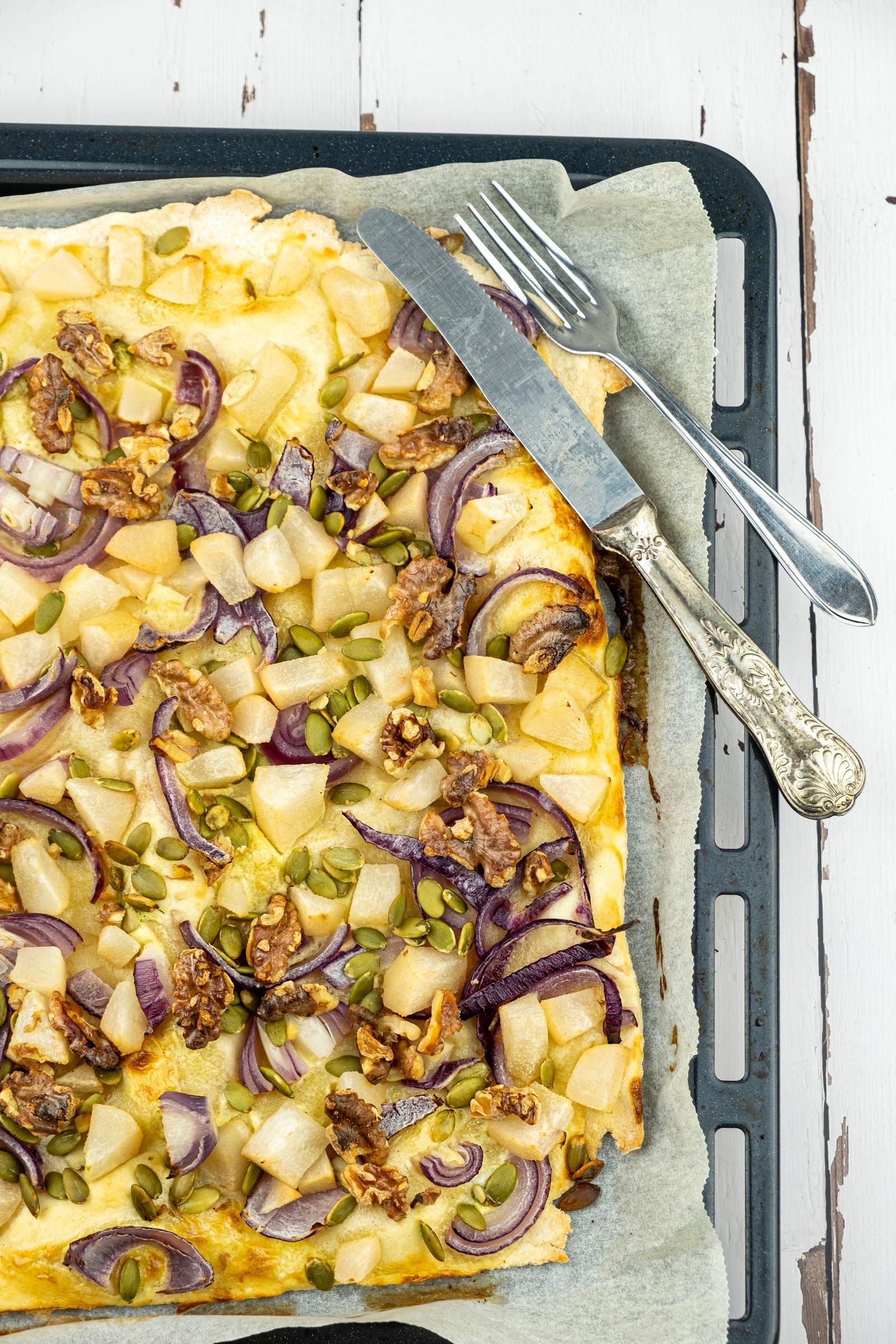
A thin, crackling flatbread spread with crème fraîche, sweet onions and smoky bacon — tarte flambée is Alsace's answer to pizza, and it is simpler, lighter and faster to make. The edges crisp, the onions soften, and the whole thing is gone within minutes of leaving the oven. It is lighter than pizza, faster to make, and every bit as satisfying.
The story behind Tarte Flambée
Tarte flambée comes from Alsace, the region of eastern France that borders Germany, and its history is tied to the wood-fired ovens of farmhouse kitchens. Bakers used a thin piece of dough to test the heat of the oven before baking bread, and they topped it with whatever was at hand: cream, onions and bacon. The test became a meal in its own right, and it has been loved in Alsace ever since. Alsace sits on the border with Germany, and its cooking mixes French finesse with German heartiness. The bakers of Alsace turned a practical test into a beloved meal.
In Alsace, tarte flambée is eaten as a shared meal, often in rounds, with one tart after another coming out of the oven while everyone sits around the table. It is the centrepiece of a convivial evening, served with a glass of local white wine and a green salad, and it is as much about the gathering as it is about the food. The French name means flame tart, a nod to the fierce heat of the oven. The name means flame tart, a nod to the fierce heat of the wood-fired oven it was born in. One tart follows another from the oven, and the evening stretches happily on.
What makes it special is the base. The dough is rolled paper-thin, so it bakes into a crisp, crackling crust with chewy, golden edges, and the topping stays light: just cream, onion and bacon, with a little cheese and nutmeg. There is no heavy tomato sauce, so the flavours stay clean and the smoky bacon shines through. Nutmeg is the quiet hero of the topping, adding warmth that you notice without quite naming. The topping stays light.
Cook it when you want something fast, fun and a little different from pizza night. It suits a Friday supper, a party snack cut into squares, or a light dinner with a big salad. The dough takes minutes to mix, the oven does the work in under 15 minutes, and the result tastes like a holiday in eastern France. The result tastes like a holiday.
- Prep time
- 30 mins
- Cook time
- 12 mins
- Total time
- 42 mins
- Servings
- 4 servings
- Calories
- 650
Ingredients
- 250 g plain flour, plus extra for dusting
- 125 ml warm water
- 1 tablespoon olive oil
- 1/2 teaspoon fine sea salt
- 200 g crème fraîche
- 150 g smoked bacon lardons or streaky bacon, diced
- 2 medium onions, halved and thinly sliced
- 50 g Gruyère cheese, finely grated, optional
- 1/4 teaspoon freshly grated nutmeg
- 1 tablespoon chopped fresh chives
- Salt and black pepper, to taste
- Green salad, to serve
- Dry white wine, such as Riesling, to serve
Instructions
- Mix the flour and salt in a large bowl, then add the warm water and olive oil and stir until a shaggy dough forms. Turn it out onto a floured surface and knead for 4 to 5 minutes, until smooth and elastic, then cover with a cloth and rest for 20 minutes.
- Heat the oven to its highest setting, at least 250 C, with a baking tray or pizza stone inside so it is hot. A very hot oven is the secret to a crisp base, so do not be tempted to bake at a lower temperature, or the tart will turn soft and soggy.
- Fry the bacon lardons in a dry pan over medium heat for 4 to 5 minutes, until the fat renders and the edges turn crisp and golden. Lift them out with a slotted spoon and drain on kitchen paper, leaving the fat in the pan for another use or discarding it.
- Soften the onions in the same pan over low heat for 5 minutes, stirring often, until they are soft and translucent but not browned. You want them sweet and tender, since they will finish cooking in the oven, and raw onion on top of the tart stays sharp and crunchy.
- Roll the dough out on a floured surface until it is as thin as you can make it, about 2 mm thick. It should be almost see-through in places, and the thinner you roll it, the crisper the finished tart will be, so keep going until you think it might tear.
- Spread the crème fraîche over the dough in a thin, even layer, leaving a 1 cm border around the edge. Season with salt, pepper and nutmeg, then scatter over the softened onions, the bacon lardons and the Gruyère, if using, keeping the topping light so the base stays crisp.
- Slide the tart onto the hot baking tray, and bake for 10 to 12 minutes until the edges are deep golden and blistered, the base is crisp, and the topping is bubbling. Watch it closely in the last few minutes, since the thin dough can go from golden to burnt very quickly.
- Lift the tart out of the oven and let it sit for 2 minutes, so the cream sets slightly and the base stays crisp. Scatter over the chives, cut the tart into squares or rectangles with a pizza cutter or a sharp knife, and serve at once while the edges are still crackling.
- If you are making a second tart, roll it out while the first one bakes, and keep the oven hot between rounds. Serve each tart as soon as it comes out, since tarte flambée waits for no one and the base softens as it cools.
Pro tips
- Roll the dough as thin as you possibly can, since a thick base turns into a heavy, bready crust. Hold the dough up to the light, and you should almost be able to see through it.
- Get the oven as hot as it will go, and preheat the tray inside, because a fierce heat is what makes the base crisp in minutes. An oven thermometer helps, since many ovens run cooler than the dial says.
- Keep the topping light, since too much cream or onion makes the centre soggy and the tart impossible to pick up. A light hand with the topping is the difference between crisp and soggy.
- Soften the onions before they go on the tart, because raw onion stays sharp and crunchy in the short baking time. Five minutes over low heat is enough to take the raw edge off the onion.
- Serve the tart the moment it leaves the oven, while the edges are still crackling and the cream is hot. Cut it with a pizza cutter for clean squares, and serve it on a wooden board.
Variations & serving ideas
For a richer version, add a handful of sliced mushrooms or a few spoonfuls of soft goat cheese, which melt into the cream and add depth. Some cooks add a thin layer of grated Emmental or Comté instead of Gruyère, which gives a nuttier, more savoury flavour. A sweet version exists too, topped with thinly sliced apples, cinnamon and a little sugar, and served as a dessert with a spoonful of cream. Thinly sliced mushrooms add an earthy depth, and they need only a quick fry before they go on the tart. A spoonful of soft goat cheese melts into the cream and adds a gentle tang to the tart.
If you are short on time, a sheet of ready-made puff pastry or a thin pizza base works as a substitute, though the result is softer and less crisp than the traditional dough. The classic dough takes only minutes to mix, so it is worth making it yourself, and it keeps in the fridge for a day if you want to prepare it ahead. A little soft goat cheese crumbled over the top melts into the cream and adds a gentle tang. Ready-made pastry is a useful shortcut on a busy night, though the base is softer.
Serve tarte flambée as a main course with a big green salad dressed with a sharp vinaigrette, which cuts through the richness of the cream and bacon. It also works as a starter, cut into small squares and shared, or as a party snack with a glass of dry white wine such as Riesling from Alsace. Cut into small squares, it makes a fine party snack, and it disappears fast. A dry white wine from Alsace is the classic drink, and it suits the rich cream.
To make a full Alsatian evening of it, serve the tart with a bowl of sauerkraut, a plate of cured meats, and a second tart with mushrooms or cheese. The meal is simple, generous and fun, and everyone at the table can help themselves to another square while the next tart bakes. Everyone helps themselves to another square while the next tart bakes in the oven.
Getting it right
The key technique is the thin dough and the hot oven. The dough must be rolled until it is almost see-through, about 2 mm thick, and the oven must be as hot as it will go, with the tray preheated inside. The fierce heat sets the dough at once, so the base crisps before the topping has time to make it soggy, and the edges blister and brown in minutes. A baking tray left in the oven while it heats acts like a pizza stone and crisps the base from below.
Timing matters most at the end of the bake. A tarte flambée goes from golden to burnt in under a minute, so watch it through the oven door for the last 2 minutes and pull it out the moment the edges are deep gold and the cream is bubbling. If the centre still looks pale, give it one more minute, but do not walk away, since the thin dough burns fast. The cream should be spread thin, like butter on toast, so the base can crisp underneath.
The most common mistake is rolling the dough too thick, which gives a soft, bready base instead of a crisp one. Another common slip is overloading the topping, which weighs the centre down and makes it soggy, so keep the cream thin and the onion and bacon scattered lightly. If the base is still soft underneath, bake the tart for 2 minutes directly on the oven rack next time. If the edges are browning faster than the centre, slide the tray to a lower shelf for the last 2 minutes.
Storing & reheating
Tarte flambée is at its best eaten fresh from the oven, and it does not keep its crispness for long. If you have leftovers, store them in a sealed container in the fridge for up to 1 day, though the base will soften. Reheat the slices on a hot baking tray at 220 C for 4 to 5 minutes until crisp again. The base will soften in the fridge, but a hot oven brings the crunch back.
The dough keeps well on its own: wrap it tightly in cling film and store it in the fridge for up to 2 days, or freeze it for up to 2 months. Thaw frozen dough overnight in the fridge, then let it come to room temperature for 20 minutes before rolling. Do not freeze a baked tart, since the cream topping turns watery and the base goes soggy after thawing.
Frequently asked questions
What is tarte flambée?
Tarte flambée is a thin, crisp flatbread from Alsace in eastern France, topped with crème fraîche, onions and bacon. It is baked in a very hot oven until the edges blister and the base crackles, and it is often compared to pizza, though it is lighter and simpler.
Can I use puff pastry instead of the dough?
Yes, a sheet of ready-made puff pastry works, though the result is softer and more buttery than the traditional crisp base. Roll it out thin, prick it with a fork, and bake it for a few minutes longer, since puff pastry needs more time to crisp.
Do I need a pizza stone?
No, a heavy baking tray preheated in the oven works just as well. The key is a very hot surface, so put the tray in the oven while it preheats and slide the tart straight onto it. A heavy tray preheated in the oven works just as well as a stone.
Can I make tarte flambée vegetarian?
Yes, leave out the bacon and add sliced mushrooms, caramelised onions, or a little soft goat cheese instead. The cream and onion base is delicious on its own, and the mushrooms add a savoury depth that replaces the smoky bacon. Caramelised onions and mushrooms make a rich vegetarian version with plenty of flavour.
Why is my base soggy in the middle?
The oven was probably not hot enough, or the topping was too heavy. Preheat the oven to its highest setting with the tray inside, roll the dough thinner, and keep the cream layer light so the base can crisp. Roll the dough thinner and turn the oven up, since a fierce heat is what crisps the base.
What wine goes with tarte flambée?
A dry white wine from Alsace, such as Riesling or Pinot Blanc, is the classic partner, since its crisp acidity cuts through the rich cream and smoky bacon. A light lager or a dry cider works well too. A dry cider is another good choice, and it pairs well with the smoky bacon.