French Macarons
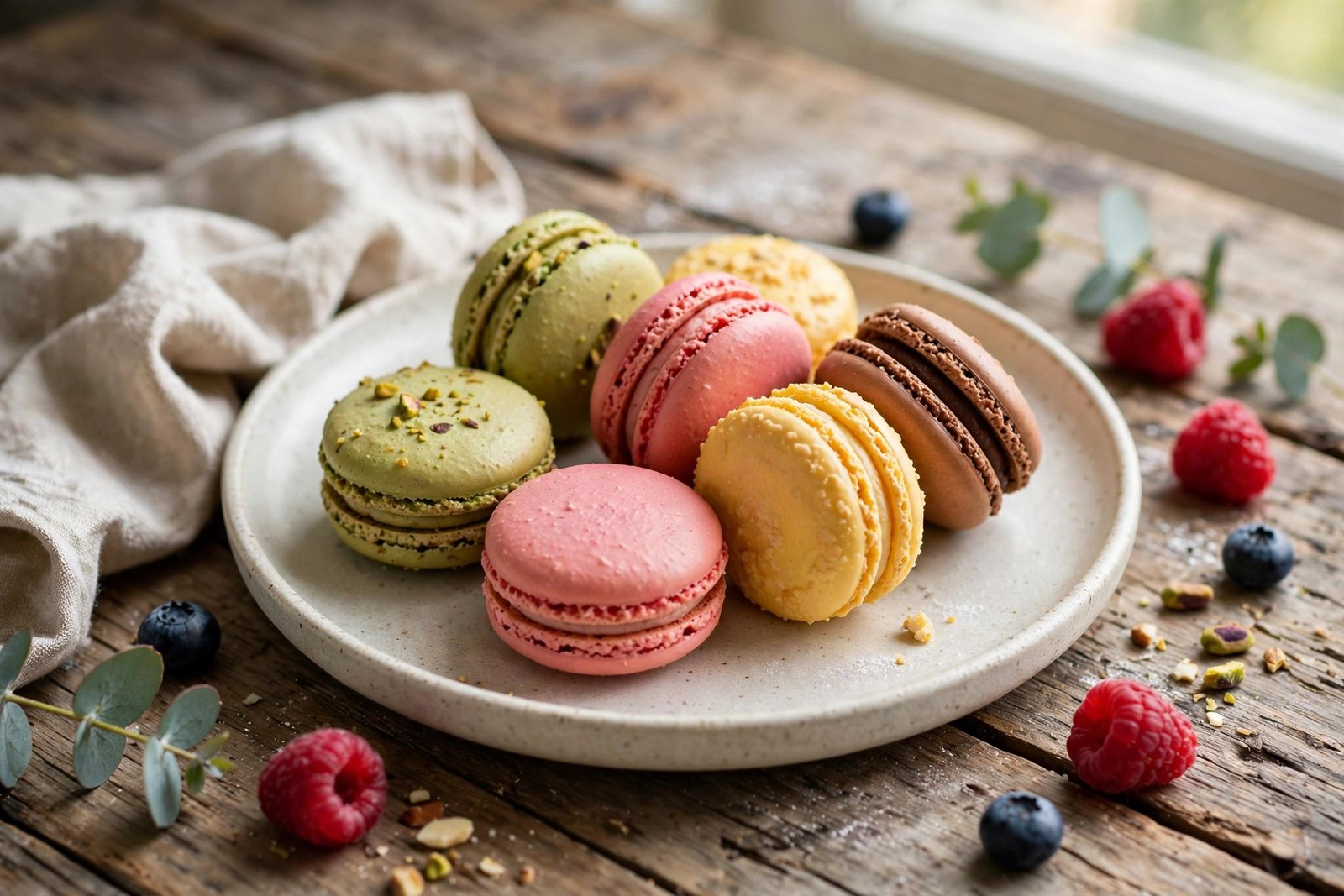
Delicate, chewy, and crowned with their signature ruffled “feet,” French macarons are the patisserie's prettiest puzzle. This method demystifies them — a proper macaronage and a patient rest yield crisp-shelled, jammy-centered sandwich cookies worth every minute.
- Prep time
- 1 hr 10 mins
- Cook time
- 16 mins
- Total time
- 1 hr 26 mins
- Servings
- 24 servings
- Calories
- 100
Ingredients
- 100 g (3.5 oz) egg whites, separated 24 hours ahead and brought to room temperature (about 3 large eggs)
- 100 g (1/2 cup) granulated sugar
- 105 g (1 cup) finely ground almond flour
- 165 g (1 1/4 cups) powdered sugar, for the shells
- 1/4 teaspoon cream of tartar
- Gel food coloring (optional)
- 120 g (1/2 cup) unsalted butter, softened
- 150 g (1 1/4 cups) powdered sugar, for the filling
- 2 tablespoons heavy cream, plus 1 teaspoon vanilla extract
Instructions
- Line two baking sheets with parchment or silicone mats. Sift the almond flour and 165 g powdered sugar together twice — discard any coarse bits that will not pass through.
- Whip the egg whites with the cream of tartar to soft peaks. Gradually add the granulated sugar and whip to stiff, glossy peaks. Add gel coloring now if using.
- Fold the dry ingredients into the meringue in three additions. Then macaronage: fold and smear the batter against the bowl until it flows like lava and a ribbon dissolves back in 10 seconds. This takes 40–50 folds — under-mixing causes cracks, over-mixing causes flat shells.
- Transfer to a piping bag fitted with a round tip. Pipe 3 cm rounds, 2 cm apart, holding the bag vertical.
- Bang each tray firmly on the counter twice to release air bubbles; pop any surface bubbles with a toothpick.
- Rest 30–45 minutes until the shells are dry to the touch and no longer tacky — this forms the skin that creates the feet.
- Bake at 150°C (300°F) for 15–16 minutes, one tray at a time, until the shells are set and lift cleanly off the parchment.
- Cool completely on the tray before peeling off — warm shells stick and break.
- Beat the butter, 150 g powdered sugar, cream, and vanilla into a smooth buttercream. Pipe onto half the shells and sandwich with matching halves.
- Mature the filled macarons in the fridge for 24 hours — the centers turn fudgy and the flavors meld. Bring to room temperature 20 minutes before serving.
Pro tips
- Weigh everything — macarons punish volume measuring more than any other cookie.
- Aged egg whites (separated a day ahead, covered in the fridge) whip more stably.
- An oven running hot is the top cause of cracked, hollow shells — use an oven thermometer.
- If your first tray fails, the batter keeps fine while you adjust; bake one test shell if unsure.
- Humid days are macaron enemies — the resting skin takes longer to form, so be patient.
Frequently asked questions
Why do my macarons have no feet?
Usually under-whipped meringue or skipping the resting step. Whip to truly stiff peaks and rest until the shells are completely dry to the touch before baking.
Why did my macarons crack?
Trapped air or an oven running hot. Bang the trays firmly, pop visible bubbles, rest fully, and verify your oven temperature with a thermometer.
Can I make macarons without almond flour?
You can try finely ground pistachio or hazelnut flour, but the texture changes. All-purpose flour versions exist but taste more like a plain cookie than a macaron.
How long do macarons keep?
Filled macarons keep 5 days refrigerated (they are best on day 2–3 after maturing) and freeze beautifully for a month.